Solar Glossary
Are you interested in solar electricity, but not sure what "photovoltaic conversion efficiency" means? You're not alone. In fact, because technical terms like these come up frequently, especially in discussions of photovoltaics (PV), we prepared this glossary of terms. In it you will find definitions of many important terms having to do with electricity, power generation, concentrating solar power (CSP), solar heating, solar lighting, and solar electricity, also known as PV.
A B C D E F G H I J K L M N O P Q R S T U V W X Y Z
A
Absorber — In a photovoltaic device, the material that readily absorbs photons to generate charge carriers (free electrons or holes).
AC — see alternating current.
Activated Shelf Life — The period of time, at a specified temperature, that a charged battery can be stored before its capacity falls to an unusable level.
Activation Voltage(s) — The voltage(s) at which a charge controller will take action to protect the batteries.
Adjustable Set Point — A feature allowing the user to adjust the voltage levels at which a charge controller will become active.
Alternating Current (AC) — A type of electrical current, the direction of which is reversed at regular intervals or cycles. In the United States, the standard is 120 reversals or 60 cycles per second. Electricity transmission networks use AC because voltage can be controlled with relative ease.
Acceptor — A dopant material, such as boron, which has fewer outer shell electrons than required in an otherwise balanced crystal structure, providing a hole, which can accept a free electron.
AIC — See amperage interrupt capability.
Air mass (sometimes called air mass ratio) — Equal to the cosine of the zenith angle-that angle from directly overhead to a line intersecting the sun. The air mass is an indication of the length of the path solar radiation travels through the atmosphere. An air mass of 1.0 means the sun is directly overhead and the radiation travels through one atmosphere (thickness).
Ambient Temperature — The temperature of the surrounding area.
Amorphous Semiconductor — A non-crystalline semiconductor material that has no long-range order.
Amorphous Silicon — A thin-film, silicon photovoltaic cell having no crystalline structure. Manufactured by depositing layers of doped silicon on a substrate. See also single-crystal silicon an polycrystalline silicon.
Amperage Interrupt Capability (AIC) — direct current fuses should be rated with a sufficient AIC to interrupt the highest possible current.
Ampere (amp) — A unit of electrical current or rate of flow of electrons. One volt across one ohm of resistance causes a current flow of one ampere.
Ampere-Hour (Ah/AH) — A measure of the flow of current (in amperes) over one hour; used to measure battery capacity.
Ampere Hour Meter — An instrument that monitors current with time. The indication is the product of current (in amperes) and time (in hours).
Angle of Incidence — The angle that a ray of sun makes with a line perpendicular to the surface. For example, a surface that directly faces the sun has a solar angle of incidence of zero, but if the surface is parallel to the sun (for example, sunrise striking a horizontal rooftop), the angle of incidence is 90°.
Annual Solar Savings — The annual solar savings of a solar building is the energy savings attributable to a solar feature relative to the energy requirements of a non-solar building.
Anode — The positive electrode in an electrochemical cell (battery). Also, the earth or ground in a cathodic protection system. Also, the positive terminal of a diode.
Antireflection Coating — A thin coating of a material applied to a solar cell surface that reduces the light reflection and increases light transmission.
Array — see photovoltaic (PV) array.
Array Current — The electrical current produced by a photovoltaic array when it is exposed to sunlight.
Array Operating Voltage — The voltage produced by a photovoltaic array when exposed to sunlight and connected to a load.
Autonomous System — See stand-alone system.
Availability — The quality or condition of a photovoltaic system being available to provide power to a load. Usually measured in hours per year. One minus availability equals downtime.
Azimuth Angle — The angle between true south and the point on the horizon directly below the sun.
Back to Top
B
Balance of System — Represents all components and costs other than the photovoltaic modules/array. It includes design costs, land, site preparation, system installation, support structures, power conditioning, operation and maintenance costs, indirect storage, and related costs.
Band Gap — In a semiconductor, the energy difference between the highest valence band and the lowest conduction band.
Band Gap Energy (Eg) — The amount of energy (in electron volts) required to free an outer shell electron from its orbit about the nucleus to a free state, and thus promote it from the valence to the conduction level.
Barrier Energy — The energy given up by an electron in penetrating the cell barrier; a measure of the electrostatic potential of the barrier.
Base Load — The average amount of electric power that a utility must supply in any period.
Battery — Two or more electrochemical cells enclosed in a container and electrically interconnected in an appropriate series/parallel arrangement to provide the required operating voltage and current levels. Under common usage, the term battery also applies to a single cell if it constitutes the entire electrochemical storage system.
Battery Available Capacity — The total maximum charge, expressed in ampere-hours, that can be withdrawn from a cell or battery under a specific set of operating conditions including discharge rate, temperature, initial state of charge, age, and cut-off voltage.
Battery Capacity — The maximum total electrical charge, expressed in ampere-hours, which a battery can deliver to a load under a specific set of conditions.
Battery Cell — The simplest operating unit in a storage battery. It consists of one or more positive electrodes or plates, an electrolyte that permits ionic conduction, one or more negative electrodes or plates, separators between plates of opposite polarity, and a container for all the above.
Battery Cycle Life — The number of cycles, to a specified depth of discharge, that a cell or battery can undergo before failing to meet its specified capacity or efficiency performance criteria.
Battery Energy Capacity — The total energy available, expressed in watt-hours (kilowatt-hours), which can be withdrawn from a fully charged cell or battery. The energy capacity of a given cell varies with temperature, rate, age, and cut-off voltage. This term is more common to system designers than it is to the battery industry where capacity usually refers to ampere-hours.
Battery Energy Storage — Energy storage using electrochemical batteries. The three main applications for battery energy storage systems include spinning reserve at generating stations, load leveling at substations, and peak shaving on the customer side of the meter.
Battery Life — The period during which a cell or battery is capable of operating above a specified capacity or efficiency performance level. Life may be measured in cycles and/or years, depending on the type of service for which the cell or battery is intended.
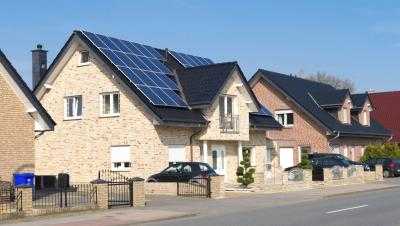
BIPV (Building-Integrated Photovoltaics) — A term for the design and integration of photovoltaic (PV) technology into the building envelope, typically replacing conventional building materials. This integration may be in vertical facades, replacing view glass, spandrel glass, or other facade material; into semitransparent skylight systems; into roofing systems, replacing traditional roofing materials; into shading "eyebrows" over windows; or other building envelope systems.
Blocking Diode — A semiconductor connected in series with a solar cell or cells and a storage battery to keep the battery from discharging through the cell when there is no output, or low output, from the solar cell. It can be thought of as a one-way valve that allows electrons to flow forwards, but not backwards.
Boron (B) — The chemical element commonly used as the dopant in photovoltaic device or cell material.
Boule — A sausage-shaped, synthetic single-crystal mass grown in a special furnace, pulled and turned at a rate necessary to maintain the single-crystal structure during growth.
Btu (British Thermal Unit) — The amount of heat required to raise the temperature of one pound of water one degree Fahrenheit; equal to 252 calories.
Bypass Diode — A diode connected across one or more solar cells in a photovoltaic module such that the diode will conduct if the cell(s) become reverse biased. It protects these solar cells from thermal destruction in case of total or partial shading of individual solar cells while other cells are exposed to full light.
Back to Top
C
Cadmium (Cd) — A chemical element used in making certain types of solar cells and batteries.
Cadmium Telluride (CdTe) — A polycrystalline thin-film photovoltaic material.
Capacity (C) — See battery capacity.
Capacity Factor — The ratio of the average load on (or power output of) an electricity generating unit or system to the capacity rating of the unit or system over a specified period of time.
Captive Electrolyte Battery — A battery having an immobilized electrolyte (gelled or absorbed in a material).
Cathode — The negative pole or electrode of an electrolytic cell, vacuum tube, etc., where electrons enter (current leaves) the system; the opposite of an anode.
Cathodic Protection — A method of preventing oxidation of the exposed metal in structures by imposing a small electrical voltage between the structure and the ground.
Cd — see cadmium.
CdTe — see cadmium telluride.
Cell (battery) — A single unit of an electrochemical device capable of producing direct voltage by converting chemical energy into electrical energy. A battery usually consists of several cells electrically connected together to produce higher voltages. (Sometimes the terms cell and battery are used interchangeably). Also see photovoltaic (PV) cell.
Cell Barrier — A very thin region of static electric charge along the interface of the positive and negative layers in a photovoltaic cell. The barrier inhibits the movement of electrons from one layer to the other, so that higher-energy electrons from one side diffuse preferentially through it in one direction, creating a current and thus a voltage across the cell. Also called depletion zone or space charge.
Cell Junction — The area of immediate contact between two layers (positive and negative) of a photovoltaic cell. The junction lies at the center of the cell barrier or depletion zone.
Charge — The process of adding electrical energy to a battery.
Charge Carrier — A free and mobile conduction electron or hole in a semiconductor.
Charge Controller — A component of a photovoltaic system that controls the flow of current to and from the battery to protect it from over-charge and over-discharge. The charge controller may also indicate the system operational status.
Charge Factor — A number representing the time in hours during which a battery can be charged at a constant current without damage to the battery. Usually expressed in relation to the total battery capacity, i.e., C/5 indicates a charge factor of 5 hours. Related to charge rate.
Charge Rate — The current applied to a cell or battery to restore its available capacity. This rate is commonly normalized by a charge control device with respect to the rated capacity of the cell or battery.
Chemical Vapor Deposition (CVD) — A method of depositing thin semiconductor films used to make certain types of photovoltaic devices. With this method, a substrate is exposed to one or more vaporized compounds, one or more of which contain desirable constituents. A chemical reaction is initiated, at or near the substrate surface, to produce the desired material that will condense on the substrate.
Cleavage of Lateral Epitaxial Films for Transfer (CLEFT) — A process for making inexpensive Gallium Arsenide (GaAs) photovoltaic cells in which a thin film of GaAs is grown atop a thick, single-crystal GaAs (or other suitable material) substrate and then is cleaved from the substrate and incorporated into a cell, allowing the substrate to be reused to grow more thin-film GaAs.
Cloud Enhancement — The increase in solar intensity caused by reflected irradiance from nearby clouds.
Combined Collector — A photovoltaic device or module that provides useful heat energy in addition to electricity.
Concentrator — A photovoltaic module, which includes optical components such as lenses (Fresnel lens) to direct and concentrate sunlight onto a solar cell of smaller area. Most concentrator arrays must directly face or track the sun. They can increase the power flux of sunlight hundreds of times.
Conduction Band (or conduction level) — An energy band in a semiconductor in which electrons can move freely in a solid, producing a net transport of charge.
Conductor — The material through which electricity is transmitted, such as an electrical wire, or transmission or distribution line.
Contact Resistance — The resistance between metallic contacts and the semiconductor.
Conversion Efficiency — See photovoltaic (conversion) efficiency.
Converter — A unit that converts a direct current (dc) voltage to another dc voltage.
Copper Indium Diselenide (CuInSe2, or CIS) — A polycrystalline thin-film photovoltaic material (sometimes incorporating gallium (CIGS) and/or sulfur).
Crystalline Silicon — A type of photovoltaic cell made from a slice of single-crystal silicon or polycrystalline silicon.
Current — See electric current.
Current at Maximum Power (Imp) — The current at which maximum power is available from a module.
Cutoff Voltage — The voltage levels (activation) at which the charge controller disconnects the photovoltaic array from the battery or the load from the battery.
Cycle — The discharge and subsequent charge of a battery.
Czochralski Process — A method of growing large size, high quality semiconductor crystal by slowly lifting a seed crystal from a molten bath of the material under careful cooling conditions.
Back to Top
D
Dangling Bonds — A chemical bond associated with an atom on the surface layer of a crystal. The bond does not join with another atom of the crystal, but extends in the direction of exterior of the surface.
Days of Storage — The number of consecutive days the stand-alone system will meet a defined load without solar energy input. This term is related to system availability.
DC — See direct current.
DC-to-DC Converter — Electronic circuit to convert direct current voltages (e.g., photovoltaic module voltage) into other levels (e.g., load voltage). Can be part of a maximum power point tracker.
Deep-Cycle Battery — A battery with large plates that can withstand many discharges to a low state-of-charge.
Deep Discharge — Discharging a battery to 20% or less of its full charge capacity.
Depth of Discharge (DOD) — The ampere-hours removed from a fully charged cell or battery, expressed as a percentage of rated capacity. For example, the removal of 25 ampere-hours from a fully charged 100 ampere-hours rated cell results in a 25% depth of discharge. Under certain conditions, such as discharge rates lower than that used to rate the cell, depth of discharge can exceed 100%.
Dendrite — A slender threadlike spike of pure crystalline material, such as silicon.
Dendritic Web Technique — A method for making sheets of polycrystalline silicon in which silicon dendrites are slowly withdrawn from a melt of silicon whereupon a web of silicon forms between the dendrites and solidifies as it rises from the melt and cools.
Depletion Zone — Same as cell barrier. The term derives from the fact that this microscopically thin region is depleted of charge carriers (free electrons and hole).
Design Month — The month having the combination of insolation and load that requires the maximum energy from the photovoltaic array.
Diffuse Insolation — Sunlight received indirectly as a result of scattering due to clouds, fog, haze, dust, or other obstructions in the atmosphere. Opposite of direct insolation.
Diffuse Radiation — Radiation received from the sun after reflection and scattering by the atmosphere and ground.
Diffusion Furnace — Furnace used to make junctions in semiconductors by diffusing dopant atoms into the surface of the material.
Diffusion Length — The mean distance a free electron or hole moves before recombining with another hole or electron.
Diode — An electronic device that allows current to flow in one direction only. See blocking diode and bypass diode.
Direct Beam Radiation — Radiation received by direct solar rays. Measured by a pyrheliometer with a solar aperture of 5.7° to transcribe the solar disc.
Direct Current (DC) — A type of electricity transmission and distribution by which electricity flows in one direction through the conductor, usually relatively low voltage and high current. To be used for typical 120 volt or 220 volt household appliances, DC must be converted to alternating current, its opposite.
Direct Insolation — Sunlight falling directly upon a collector. Opposite of diffuse insolation.
Discharge — The withdrawal of electrical energy from a battery.
Discharge Factor — A number equivalent to the time in hours during which a battery is discharged at constant current usually expressed as a percentage of the total battery capacity, i.e., C/5 indicates a discharge factor of 5 hours. Related to discharge rate.
Discharge Rate — The rate, usually expressed in amperes or time, at which electrical current is taken from the battery.
Disconnect — Switch gear used to connect or disconnect components in a photovoltaic system.
Distributed Energy Resources (DER) — A variety of small, modular power-generating technologies that can be combined with energy management and storage systems and used to improve the operation of the electricity delivery system, whether or not those technologies are connected to an electricity grid.
Distributed Generation — A popular term for localized or on-site power generation.
Distributed Power — Generic term for any power supply located near the point where the power is used. Opposite of central power. See stand-alone systems.
Distributed Systems — Systems that are installed at or near the location where the electricity is used, as opposed to central systems that supply electricity to grids. A residential photovoltaic system is a distributed system.
Donor — In a photovoltaic device, an n-type dopant, such as phosphorus, that puts an additional electron into an energy level very near the conduction band; this electron is easily exited into the conduction band where it increases the electrical conductivity over than of an undoped semiconductor.
Donor Level — The level that donates conduction electrons to the system.
Dopant — A chemical element (impurity) added in small amounts to an otherwise pure semiconductor material to modify the electrical properties of the material. An n-dopant introduces more electrons. A p-dopant creates electron vacancies (holes).
Doping — The addition of dopants to a semiconductor.
Downtime — Time when the photovoltaic system cannot provide power for the load. Usually expressed in hours per year or that percentage.
Dry Cell — A cell (battery) with a captive electrolyte. A primary battery that cannot be recharged.
Duty Cycle — The ratio of active time to total time. Used to describe the operating regime of appliances or loads in photovoltaic systems.
Duty Rating — The amount of time an inverter (power conditioning unit) can produce at full rated power.
Back to Top
E
Edge-Defined Film-Fed Growth (EFG) — A method for making sheets of polycrystalline silicon for photovoltaic devices in which molten silicon is drawn upward by capillary action through a mold.
Electric Circuit — The path followed by electrons from a power source (generator or battery), through an electrical system, and returning to the source.
Electric Current — The flow of electrical energy (electricity) in a conductor, measured in amperes.
Electrical grid — An integrated system of electricity distribution, usually covering a large area.
Electricity — Energy resulting from the flow of charge particles, such as electrons or ions.
Electrochemical Cell — A device containing two conducting electrodes, one positive and the other negative, made of dissimilar materials (usually metals) that are immersed in a chemical solution (electrolyte) that transmits positive ions from the negative to the positive electrode and thus forms an electrical charge. One or more cells constitute a battery.
Electrode — A conductor that is brought in conducting contact with a ground.
Electrodeposition — Electrolytic process in which a metal is deposited at the cathode from a solution of its ions.
Electrolyte — A nonmetallic (liquid or solid) conductor that carries current by the movement of ions (instead of electrons) with the liberation of matter at the electrodes of an electrochemical cell.
Electron — An elementary particle of an atom with a negative electrical charge and a mass of 1/1837 of a proton; electrons surround the positively charged nucleus of an atom and determine the chemical properties of an atom. The movement of electrons in an electrical conductor constitutes an electric current.
Electron Volt (eV) — The amount of kinetic energy gained by an electron when accelerated through an electric potential difference of 1 Volt; equivalent to 1.603 x 10^-19; a unit of energy or work.
Energy — The capability of doing work; different forms of energy can be converted to other forms, but the total amount of energy remains the same.
Energy Audit — A survey that shows how much energy used in a home, which helps find ways to use less energy.
Energy Contribution Potential — Recombination occurring in the emitter region of a photovoltaic cell.
Energy Density — The ratio of available energy per pound; usually used to compare storage batteries.
Energy Levels — The energy represented by an electron in the band model of a substance.
Epitaxial Growth — The growth of one crystal on the surface of another crystal. The growth of the deposited crystal is oriented by the lattice structure of the original crystal.
Equalization — The process of restoring all cells in a battery to an equal state-of-charge. Some battery types may require a complete discharge as a part of the equalization process.
Equalization Charge — The process of mixing the electrolyte in batteries by periodically overcharging the batteries for a short time.
Equalizing Charge — A continuation of normal battery charging, at a voltage level slightly higher than the normal end-of-charge voltage, in order to provide cell equalization within a battery.
Equinox — The two times of the year when the sun crosses the equator and night and day are of equal length; usually occurs on March 21st (spring equinox) and September 23 (fall equinox).
Extrinsic Semiconductor — The product of doping a pure semiconductor.
Back to Top
F
Fermi Level — Energy level at which the probability of finding an electron is one-half. In a metal, the Fermi level is very near the top of the filled levels in the partially filled valence band. In a semiconductor, the Fermi level is in the band gap.
Fill Factor — The ratio of a photovoltaic cell's actual power to its power if both current and voltage were at their maxima. A key characteristic in evaluating cell performance.
Fixed Tilt Array — A photovoltaic array set in at a fixed angle with respect to horizontal.
Flat-Plate Array — A photovoltaic (PV) array that consists of non-concentrating PV modules.
Flat-Plate Module — An arrangement of photovoltaic cells or material mounted on a rigid flat surface with the cells exposed freely to incoming sunlight.
Flat-Plate Photovoltaics (PV) — A PV array or module that consists of nonconcentrating elements. Flat-plate arrays and modules use direct and diffuse sunlight, but if the array is fixed in position, some portion of the direct sunlight is lost because of oblique sun-angles in relation to the array.
Float Charge — The voltage required to counteract the self-discharge of the battery at a certain temperature.
Float Life — The number of years that a battery can keep its stated capacity when it is kept at float charge.
Float Service — A battery operation in which the battery is normally connected to an external current source; for instance, a battery charger which supplies the battery load< under normal conditions, while also providing enough energy input to the battery to make up for its internal quiescent losses, thus keeping the battery always up to full power and ready for service.
Float-Zone Process — A method of growing a large-size, high-quality crystal whereby coils heat a polycrystalline ingot placed atop a single-crystal seed. As the coils are slowly raised the molten interface beneath the coils becomes single crystal.
Float-Zone Process — In reference to solar photovoltaic cell manufacture, a method of growing a large-size, high-quality crystal whereby coils heat a polycrystalline ingot placed atop a single-crystal seed. As the coils are slowly raised the molten interface beneath the coils becomes a single crystal.
Frequency — The number of repetitions per unit time of a complete waveform, expressed in Hertz (Hz).
Frequency Regulation — This indicates the variability in the output frequency. Some loads will switch off or not operate properly if frequency variations exceed 1%.
Fresnel Lens — An optical device that focuses light like a magnifying glass; concentric rings are faced at slightly different angles so that light falling on any ring is focused to the same point.
Full Sun — The amount of power density in sunlight received at the earth's surface at noon on a clear day (about 1,000 Watts/square meter).
Back to Top
G
Ga — See gallium.
GaAs — See gallium arsenide.
Gallium (Ga) — A chemical element, metallic in nature, used in making certain kinds of solar cells and semiconductor devices.
Gallium Arsenide (GaAs) — A crystalline, high-efficiency compound used to make certain types of solar cells and semiconductor material.
Gassing — The evolution of gas from one or more of the electrodes in the cells of a battery. Gassing commonly results from local action self-discharge or from the electrolysis of water in the electrolyte during charging.
Gassing Current — The portion of charge current that goes into electrolytical production of hydrogen and oxygen from the electrolytic liquid. This current increases with increasing voltage and temperature.
Gel-Type Battery — Lead-acid battery in which the electrolyte is composed of a silica gel matrix.
Gigawatt (GW) — A unit of power equal to 1 billion Watts; 1 million kilowatts, or 1,000 megawatts.
Grid — See electrical grid.
Grid-Connected System — A solar electric or photovoltaic (PV) system in which the PV array acts like a central generating plant, supplying power to the grid.
Grid-Interactive System — Same as grid-connected system.
Grid Lines — Metallic contacts fused to the surface of the solar cell to provide a low resistance path for electrons to flow out to the cell interconnect wires.
Back to Top
H
Harmonic Content — The number of frequencies in the output waveform in addition to the primary frequency (50 or 60 Hz.). Energy in these harmonic frequencies is lost and may cause excessive heating of the load.
Heterojunction — A region of electrical contact between two different materials.
High Voltage Disconnect — The voltage at which a charge controller will disconnect the photovoltaic array from the batteries to prevent overcharging.
High Voltage Disconnect Hysteresis — The voltage difference between the high voltag disconnect set point and the voltage at which the full photovoltaic array current will be reapplied.
Hole — The vacancy where an electron would normally exist in a solid; behaves like a positively charged particle.
Homojunction — The region between an n-layer and a p-layer in a single material, photovoltaic cell.
Hybrid System — A solar electric or photovoltaic system that includes other sources of electricity generation, such as wind or diesel generators.
Hydrogenated Amorphous Silicon — Amorphous silicon with a small amount of incorporated hydrogen. The hydrogen neutralizes dangling bonds in the amorphous silicon, allowing charge carriers to flow more freely.
Back to Top
I
Incident Light — Light that shines onto the face of a solar cell or module.
Indium Oxide — A wide band gap semiconductor that can be heavily doped with tin to make a highly conductive, transparent thin film. Often used as a front contact or one component of a heterojunction solar cell.
Infrared Radiation — Electromagnetic radiation whose wavelengths lie in the range from 0.75 micrometer to 1000 micrometers; invisible long wavelength radiation (heat) capable of producing a thermal or photovoltaic effect, though less effective than visible light.
Input Voltage — This is determined by the total power required by the alternating current loads and the voltage of any direct current loads. Generally, the larger the load, the higher the inverter input voltage. This keeps the current at levels where switches and other components are readily available.
Insolation — The solar power density incident on a surface of stated area and orientation, usually expressed as Watts per square meter or Btu per square foot per hour. See diffuse insolation and direct insolation.
Interconnect — A conductor within a module or other means of connection that provides an electrical interconnection between the solar cells.
Intrinsic Layer — A layer of semiconductor material, used in a photovoltaic device, whose properties are essentially those of the pure, undoped, material.
Intrinsic Semiconductor — An undoped semiconductor.
Inverter — A device that converts direct current electricity to alternating current either for stand-alone systems or to supply power to an electricity grid.
Ion — An electrically charged atom or group of atoms that has lost or gained electrons; a loss makes the resulting particle positively charged; a gain makes the particle negatively charged.
Irradiance — The direct, diffuse, and reflected solar radiation that strikes a surface. Usually expressed in kilowatts per square meter. Irradiance multiplied by time equals insolation.
ISPRA Guidelines — Guidelines for the assessment of photovoltaic power plants, published by the Joint Research Centre of the Commission of the European Communities, Ispra, Italy.
I-Type Semiconductor — Semiconductor material that is left intrinsic, or undoped so that the concentration of charge carriers is characteristic of the material itself rather than of added impurities.
I-V Curve — A graphical presentation of the current versus the voltage from a photovoltaic device as the load is increased from the short circuit (no load) condition to the open circuit (maximum voltage) condition. The shape of the curve characterizes cell performance.
Back to Top
J
Joule — A metric unit of energy or work; 1 joule per second equals 1 watt or 0.737 foot-pounds; 1 Btu equals 1,055 joules.
Junction — A region of transition between semiconductor layers, such as a p/n junction, which goes from a region that has a high concentration of acceptors (p-type) to one that has a high concentration of donors (n-type).
Junction Box — A photovoltaic (PV) generator junction box is an enclosure on the module where PV strings are electrically connected and where protection devices can be located, if necessary.
Junction Diode — A semiconductor device with a junction and a built-in potential that passes current better in one direction than the other. All solar cells are junction diodes.
Back to Top
K
Kilowatt (kW) — A standard unit of electrical power equal to 1000 watts, or to the energy consumption at a rate of 1000 joules per second.
Kilowatt-Hour (kWh) — 1,000 thousand watts acting over a period of 1 hour. The kWh is a unit of energy. 1 kWh=3600 kJ.
Back to Top
L
Langley (L) — Unit of solar irradiance. One gram calorie per square centimeter. 1 L = 85.93 kwh/m2.
Lattice — The regular periodic arrangement of atoms or molecules in a crystal of semiconductor material.
Lead-Acid Battery — A general category that includes batteries with plates made of pure lead, lead-antimony, or lead-calcium immersed in an acid electrolyte.
Life — The period during which a system is capable of operating above a specified performance level.
Life-Cycle Cost — The estimated cost of owning and operating a photovoltaic system for the period of its useful life.
Light-Induced Defects — Defects, such as dangling bonds, induced in an amorphous silicon semiconductor upon initial exposure to light.
Light Trapping — The trapping of light inside a semiconductor material by refracting and reflecting the light at critical angles; trapped light will travel further in the material, greatly increasing the probability of absorption and hence of producing charge carriers.
Line-Commutated Inverter — An inverter that is tied to a power grid or line. The commutation of power (conversion from direct current to alternating current) is controlled by the power line, so that, if there is a failure in the power grid, the photovoltaic system cannot feed power into the line.
Liquid Electrolyte Battery — A battery containing a liquid solution of acid and water. Distilled water may be added to these batteries to replenish the electrolyte as necessary. Also called a flooded battery because the plates are covered with the electrolyte.
Load — The demand on an energy producing system; the energy consumption or requirement of a piece or group of equipment. Usually expressed in terms of amperes or watts in reference to electricity.
Load Circuit — The wire, switches, fuses, etc. that connect the load to the power source.
Load Current (A) — The current required by the electrical device.
Load Resistance — The resistance presented by the load. See resistance.
Low Voltage Cutoff (LVC) — The voltage level at which a charge controller will disconnect the load from the battery.
Low Voltage Disconnect — The voltage at which a charge controller will disconnect the load from the batteries to prevent over-discharging.
Low Voltage Disconnect Hysteresis — The voltage difference between the low voltage disconnect set point and the voltage at which the load will be reconnected.
Low Voltage Warning — A warning buzzer or light that indicates the low battery voltage set point has been reached.
Back to Top
M
Maintenance-Free Battery — A sealed battery to which water cannot be added to maintain electrolyte level.
Majority Carrier — Current carriers (either free electrons or holes) that are in excess in a specific layer of a semiconductor material (electrons in the n-layer, holes in the p-layer) of a cell.
Maximum Power Point (MPP) — The point on the current-voltage (I-V) curve of a module under illumination, where the product of current and voltage is maximum. For a typical silicon cell, this is at about 0.45 volts.
Maximum Power Point Tracker (MPPT) — Means of a power conditioning unit that automatically operates the photovoltaic generator at its maximum power point under all conditions.
Maximum Power Tracking — Operating a photovoltaic array at the peak power point of the array's I-V curve where maximum power is obtained. Also called peak power tracking.
Megawatt (MW) — 1,000 kilowatts, or 1 million watts; standard measure of electric power plant generating capacity.
Megawatt-Hour — 1,000 kilowatt-hours or 1 million watt-hours.
Microgroove — A small groove scribed into the surface of a solar cell, which is filled with metal for contacts.
Minority Carrier — A current carrier, either an electron or a hole, that is in the minority in a specific layer of a semiconductor material; the diffusion of minority carriers under the action of the cell junction voltage is the current in a photovoltaic device.
Minority Carrier Lifetime — The average time a minority carrier exists before recombination.
Modified Sine Wave — A waveform that has at least three states (i.e., positive, off, and negative). Has less harmonic content than a square wave.
Modularity — The use of multiple inverters connected in parallel to service different loads.
Module — See photovoltaic (PV) module.
Module Derate Factor — A factor that lowers the photovoltaic module current to account for field operating conditions such as dirt accumulation on the module.
Monolithic — Fabricated as a single structure.
Movistor — Metal Oxide Varistor. Used to protect electronic circuits from surge currents such as those produced by lightning.
Multicrystalline — A semiconductor (photovoltaic) material composed of variously oriented, small, individual crystals. Sometimes referred to as polycrystalline or semicrystalline.
Multijunction Device — A high-efficiency photovoltaic device containing two or more cell junctions, each of which is optimized for a particular part of the solar spectrum.
Multi-Stage Controller — A charging controller unit that allows different charging currents as the battery nears full state_of_charge.
Back to Top
N
National Electrical Code (NEC) — Contains guidelines for all types of electrical installations. The 1984 and later editions of the NEC contain Article 690, "Solar Photovoltaic Systems" which should be followed when installing a PV system.
National Electrical Manufacturers Association (NEMA) — This organization sets standards for some non-electronic products like junction boxes.
NEC — See National Electrical Code.
NEMA — See National Electrical Manufacturers Association.
Nickel Cadmium Battery — A battery containing nickel and cadmium plates and an alkaline electrolyte.
Nominal Voltage — A reference voltage used to describe batteries, modules, or systems (i.e., a 12-volt or 24-volt battery, module, or system).
Normal Operating Cell Temperature (NOCT) — The estimated temperature of a photovoltaic module when operating under 800 w/m2 irradiance, 20C ambient temperature and wind speed of 1 meter per second. NOCT is used to estimate the nominal operating temperature of a module in its working environment.
N-Type — Negative semiconductor material in which there are more electrons than holes; current is carried through it by the flow of electrons.
N-Type Semiconductor — A semiconductor produced by doping an intrinsic semiconductor with an electron-donor impurity (e.g., phosphorus in silicon).
N-Type Silicon — Silicon material that has been doped with a material that has more electrons in its atomic structure than does silicon.
Back to Top
O
Ohm — A measure of the electrical resistance of a material equal to the resistance of a circuit in which the potential difference of 1 volt produces a current of 1 ampere.
One-Axis Tracking — A system capable of rotating about one axis.
Open-Circuit Voltage (Voc) — The maximum possible voltage across a photovoltaic cell; the voltage across the cell in sunlight when no current is flowing.
Operating Point — The current and voltage that a photovoltaic module or array produces when connected to a load. The operating point is dependent on the load or the batteries connected to the output terminals of the array.
Orientation — Placement with respect to the cardinal directions, N, S, E, W; azimuth is the measure of orientation from north.
Outgas — See gassing.
Overcharge — Forcing current into a fully charged battery. The battery will be damaged if overcharged for a long period.
Back to Top
P
Packing Factor — The ratio of array area to actual land area or building envelope area for a system; or, the ratio of total solar cell area to the total module area, for a module.
Panel — See photovoltaic (PV) panel.
Parallel Connection — A way of joining solar cells or photovoltaic modules by connecting positive leads together and negative leads together; such a configuration increases the current, but not the voltage.
Passivation — A chemical reaction that eliminates the detrimental effect of electrically reactive atoms on a solar cell's surface.
Peak Demand/Load — The maximum energy demand or load in a specified time period.
Peak Power Current — Amperes produced by a photovoltaic module or array operating at the voltage of the I-V curve that will produce maximum power from the module.
Peak Power Point — Operating point of the I-V (current-voltage) curve for a solar cell or photovoltaic module where the product of the current value times the voltage value is a maximum.
Peak Power Tracking — see maximum power tracking.
Peak Sun Hours — The equivalent number of hours per day when solar irradiance averages 1,000 w/m2. For example, six peak sun hours means that the energy received during total daylight hours equals the energy that would have been received had the irradiance for six hours been 1,000 w/m2.
Peak Watt — A unit used to rate the performance of solar cells, modules, or arrays; the maximum nominal output of a photovoltaic device, in watts (Wp) under standardized test conditions, usually 1,000 watts per square meter of sunlight with other conditions, such as temperature specified.
Phosphorous (P) — A chemical element used as a dopant in making n-type semiconductor layers.
Photocurrent — An electric current induced by radiant energy.
Photoelectric Cell — A device for measuring light intensity that works by converting light falling on, or reach it, to electricity, and then measuring the current; used in photometers.
Photoelectrochemical Cell — A type of photovoltaic device in which the electricity induced in the cell is used immediately within the cell to produce a chemical, such as hydrogen, which can then be withdrawn for use.
Photon — A particle of light that acts as an individual unit of energy.
Photovoltaic(s) (PV) — Pertaining to the direct conversion of light into electricity.
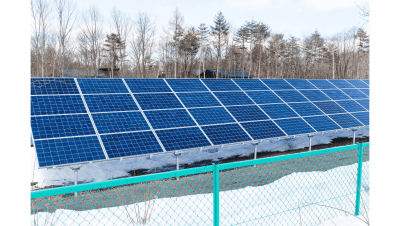
Photovoltaic (PV) Array — An interconnected system of PV modules that function as a single electricity-producing unit. The modules are assembled as a discrete structure, with common support or mounting. In smaller systems, an array can consist of a single module.
Photovoltaic (PV) Cell — The smallest semiconductor element within a PV module to perform the immediate conversion of light into electrical energy (direct current voltage and current). Also called a solar cell.
Photovoltaic (PV) Conversion Efficiency — The ratio of the electric power produced by a photovoltaic device to the power of the sunlight incident on the device.
Photovoltaic (PV) Device — A solid-state electrical device that converts light directly into direct current electricity of voltage-current characteristics that are a function of the characteristics of the light source and the materials in and design of the device. Solar photovoltaic devices are made of various semiconductor materials including silicon, cadmium sulfide, cadmium telluride, and gallium arsenide, and in single crystalline, multicrystalline, or amorphous forms.
Photovoltaic (PV) Effect — The phenomenon that occurs when photons, the "particles" in a beam of light, knock electrons loose from the atoms they strike. When this property of light is combined with the properties of semiconductors, electrons flow in one direction across a junction, setting up a voltage. With the addition of circuitry, current will flow and electric power will be available.
Photovoltaic (PV) Generator — The total of all PV strings of a PV power supply system, which are electrically interconnected.
Photovoltaic (PV) Module — The smallest environmentally protected, essentially planar assembly of solar cells and ancillary parts, such as interconnections, terminals, [and protective devices such as diodes] intended to generate direct current power under unconcentrated sunlight. The structural (load carrying) member of a module can either be the top layer (superstrate) or the back layer (substrate).
Photovoltaic (PV) Panel — often used interchangeably with PV module (especially in one-module systems), but more accurately used to refer to a physically connected collection of modules (i.e., a laminate string of modules used to achieve a required voltage and current).
Photovoltaic (PV) System — A complete set of components for converting sunlight into electricity by the photovoltaic process, including the array and balance of system components.
Photovoltaic-Thermal (PV/T) System — A photovoltaic system that, in addition to converting sunlight into electricity, collects the residual heat energy and delivers both heat and electricity in usable form. Also called a total energy system.
Physical Vapor Deposition — A method of depositing thin semiconductor photovoltaic films. With this method, physical processes, such as thermal evaporation or bombardment of ions, are used to deposit elemental semiconductor material on a substrate.
P-I-N — A semiconductor photovoltaic (PV) device structure that layers an intrinsic semiconductor between a p-type semiconductor and an n-type semiconductor; this structure is most often used with amorphous silicon PV devices.
Plates — A metal plate, usually lead or lead compound, immersed in the electrolyte in a battery.
P/N — A semiconductor photovoltaic device structure in which the junction is formed between a p-type layer and an n-type layer.
Pocket Plate — A plate for a battery in which active materials are held in a perforated metal pocket.
Point-Contact Cell — A high efficiency silicon photovoltaic concentrator cell that employs light trapping techniques and point-diffused contacts on the rear surface for current collection.
Polycrystalline — See Multicrystalline.
Polycrystalline Silicon — A material used to make photovoltaic cells, which consist of many crystals unlike single-crystal silicon.
Power Conditioning — The process of modifying the characteristics of electrical power (for e.g., inverting direct current to alternating current).
Power Conditioning Equipment — Electrical equipment, or power electronics, used to convert power from a photovoltaic array into a form suitable for subsequent use. A collective term for inverter, converter, battery charge regulator, and blocking diode.
Power Conversion Efficiency — The ratio of output power to input power of the inverter.
Power Density — The ratio of the power available from a battery to its mass (W/kg) or volume (W/l).
Power Factor (PF) — The ratio of actual power being used in a circuit, expressed in watts or kilowatts, to the power that is apparently being drawn from a power source, expressed in volt-amperes or kilovolt-amperes.
Primary Battery — A battery whose initial capacity cannot be restored by charging.
Projected Area — The net south-facing glazing area projected on a vertical plane.
P-Type Semiconductor — A semiconductor in which holes carry the current; produced by doping an intrinsic semiconductor with an electron acceptor impurity (e.g., boron in silicon).
Pulse-Width-Modulated (PWM) Wave Inverter — A type of power inverter that produce a high quality (nearly sinusoidal) voltage, at minimum current harmonics.
PV — See photovoltaic(s).
Pyranometer — An instrument used for measuring global solar irradiance.
Pyrheliometer — An instrument used for measuring direct beam solar irradiance. Uses an aperture of 5.7° to transcribe the solar disc.
Q
Quad — One quadrillion Btu (1,000,000,000,000,000 Btu).
Qualification Test — A procedure applied to a selected set of photovoltaic modules involving the application of defined electrical, mechanical, or thermal stress in a prescribed manner and amount. Test results are subject to a list of defined requirements.
Back to Top
R
Rated Battery Capacity — The term used by battery manufacturers to indicate the maximum amount of energy that can be withdrawn from a battery under specified discharge rate and temperature. See battery capacity.
Rated Module Current (A) — The current output of a photovoltaic module measured at standard test conditions of 1,000 w/m2 and 25C cell temperature.
Rated Power — Rated power of the inverter. However, some units can not produce rated power continuously. See duty rating.
Reactive Power — The sine of the phase angle between the current and voltage waveforms in an alternating current system. See power factor.
Recombination — The action of a free electron falling back into a hole. Recombination processes are either radiative, where the energy of recombination results in the emission of a photon, or nonradiative, where the energy of recombination is given to a second electron which then relaxes back to its original energy by emitting phonons. Recombination can take place in the bulk of the semiconductor, at the surfaces, in the junction region, at defects, or between interfaces.
Rectifier — A device that converts alternating current to direct current. See inverter.
Regulator — Prevents overcharging of batteries by controlling charge cycle-usually adjustable to conform to specific battery needs.
Remote Systems — See stand-alone systems.
Reserve Capacity — The amount of generating capacity a central power system must maintain to meet peak loads.
Resistance (R) — The property of a conductor, which opposes the flow of an electric current resulting in the generation of heat in the conducting material. The measure of the resistance of a given conductor is the electromotive force needed for a unit current flow. The unit of resistance is ohms.
Resistive Voltage Drop — The voltage developed across a cell by the current flow through the resistance of the cell.
Reverse Current Protection — Any method of preventing unwanted current flow from the battery to the photovoltaic array (usually at night). See blocking diode.
Ribbon (Photovoltaic) Cells — A type of photovoltaic device made in a continuous process of pulling material from a molten bath of photovoltaic material, such as silicon, to form a thin sheet of material.
RMS — See root mean square.
Root Mean Square (RMS) — The square root of the average square of the instantaneous values of an ac output. For a sine wave the RMS value is 0.707 times the peak value. The equivalent value of alternating current, I, that will produce the same heating in a conductor with resistance, R, as a dc current of value I.
Back to Top
S
Sacrificial Anode — A piece of metal buried near a structure that is to be protected from corrosion. The metal of the sacrificial anode is intended to corrode and reduce the corrosion of the protected structure.
Satellite Power System (SPS) — Concept for providing large amounts of electricity for use on the Earth from one or more satellites in geosynchronous Earth orbit. A very large array of solar cells on each satellite would provide electricity, which would be converted to microwave energy and beamed to a receiving antenna on the ground. There, it would be reconverted into electricity and distributed the same as any other centrally generated power, through a grid.
Schottky Barrier — A cell barrier established as the interface between a semiconductor, such as silicon, and a sheet of metal.
Scribing — The cutting of a grid pattern of grooves in a semiconductor material, generally for the purpose of making interconnections.
Sealed Battery — A battery with a captive electrolyte and a resealing vent cap, also called a valve-regulated battery. Electrolyte cannot be added.
Seasonal Depth of Discharge — An adjustment factor used in some system sizing procedures which "allows" the battery to be gradually discharged over a 30-90 day period of poor solar insolation. This factor results in a slightly smaller photovoltaic array.
Secondary Battery — A battery that can be recharged.
Self-Discharge — The rate at which a battery, without a load, will lose its charge.
Semiconductor — Any material that has a limited capacity for conducting an electric current. Certain semiconductors, including silicon, gallium arsenide, copper indium diselenide, and cadmium telluride, are uniquely suited to the photovoltaic conversion process.
Semicrystalline — See Multicrystalline.
Series Connection — A way of joining photovoltaic cells by connecting positive leads to negative leads; such a configuration increases the voltage.
Series Controller — A charge controller that interrupts the charging current by open-circuiting the photovoltaic (PV) array. The control element is in series with the PV array and battery.
Series Regulator — Type of battery charge regulator where the charging current is controlled by a switch connected in series with the photovoltaic module or array.
Series Resistance — Parasitic resistance to current flow in a cell due to mechanisms such as resistance from the bulk of the semiconductor material, metallic contacts, and interconnections.
Shallow-Cycle Battery — A battery with small plates that cannot withstand many discharges to a low state-of-charge.
Shelf Life of Batteries — The length of time, under specified conditions, that a battery can be stored so that it keeps its guaranteed capacity.
Short-Circuit Current (Isc) — The current flowing freely through an external circuit that has no load or resistance; the maximum current possible.
Shunt Controller — A charge controller that redirects or shunts the charging current away from the battery. The controller requires a large heat sink to dissipate the current from the short-circuited photovoltaic array. Most shunt controllers are for smaller systems producing 30 amperes or less.
Shunt Regulator — Type of a battery charge regulator where the charging current is controlled by a switch connected in parallel with the photovoltaic (PV) generator. Shorting the PV generator prevents overcharging of the battery.
Siemens Process — A commercial method of making purified silicon.
Silicon (Si) — A semi-metallic chemical element that makes an excellent semiconductor material for photovoltaic devices. It crystallizes in face-centered cubic lattice like a diamond. It's commonly found in sand and quartz (as the oxide).
Sine Wave — A waveform corresponding to a single-frequency periodic oscillation that can be mathematically represented as a function of amplitude versus angle in which the value of the curve at any point is equal to the sine of that angle.
Sine Wave Inverter — An inverter that produces utility-quality, sine wave power forms.
Single-Crystal Material — A material that is composed of a single crystal or a few large crystals.
Single-Crystal Silicon — Material with a single crystalline formation. Many photovoltaic cells are made from single-crystal silicon.
Single-Stage Controller — A charge controller that redirects all charging current as the battery nears full state-of-charge.
Solar Cell — see photovoltaic (PV) cell.
Solar Constant — The average amount of solar radiation that reaches the earth's upper atmosphere on a surface perpendicular to