Move would reassure solar market, investors

Italian government expected to extend feed-in tariff
May 05, 2011

The Italian government’s environment and industry ministers have reached an agreement over the country’s rich feed-in tariff and solar incentives that could be presented to the Cabinet as early as Today (May 5). The country was supposed to issue a new decree as early as April, but it took significantly longer, raising uncertainty over the solar policy’s fate.

The uncertainty led to volatility throughout the solar industry, but the pending policy should help assuage investors, manufacturers and developers.

Italy was the second largest solar installation market in the world, behind Germany, in 2010. At the end of last year it had added 2.3 gigawatts of solar power into its energy mix, bringing the total amount of solar in the country to 3.4 gigawatts.

Thanks to an extension of the feed-in tariff last year, as much as 4 more gigawatts could be covered under the feed-in tariff if they’re completed and connected to the grid by the end of June.

"I think we can arrive at 7,000 megawatts at the end of June," Gerardo Montanino, operating division director of Italy’s state energy services agency, GSE, told Reuters.

Under the draft decree, the country’s solar incentives would likely be reduced between 22 percent to 30 percent in 2011, 23 percent to 45 percent in 2012 and 10 percent to 45 percent in 2013, according to Reuters.

It’s too early to definitively tell what effect the policy change will really have on the solar industry, said Shayle Kann, GTM Research managing director of solar research.

“There are still things in play,” he said.

But the preliminary news is promising, he said.

“In short, I think overall the news is quite positive,” said Kann. “They’re significantly reducing incentives, but not too much.”

Italy plans to cap the amount of incentives it offers for large-scale solar installations, according to Kann. But it doesn’t cap smaller installations, like rooftop installations at all.

“The market will migrate back to the small rooftop market—and that’s what Germany is. Given that that’s an untapped market we’ll see more of that this year,” he said. “I don’t think anyone is giving up on the Italian market yet.”

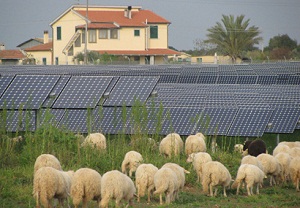
Pictured: The Montalto di Casto installation in Italy. Image courtesy of SunPower.



Your Comments

#1 JOHN GIORDANO on 7.09.2011 at 3:01 PM

P.O. Box 620263, Las Vegas, Nevada 89122, United States of America, 702-496-1990, newhorizonsglobalconcepts.com , email nhgc@usa.com

Magnetic Field Sustainable Energy

Sustainable energy can be well understood if we attempt to understand it is a type of energy source that has been with us from the beginning of time. Magneto-motive energy has been with us from the dawn of time. Imagination the bewilderment of Magnes. ( He was an elderly shepherd) when he discovered that the iron tip of his staff became stuck to a large black rock. Living in the area of Northern Greece called Magnesia, this invisible power motivated people to believe in magical properties and mystical powers of the black rock. As civilization moved forward into the future, Hans Christian Oersted (1777-1851 Danish) demonstrated how magnetism was related to electricity.

Past Sources of Reliable Sustainable Energy

The past list of sources of sustainable energy are solar energy, wind energy, geothermal and nuclear energy. The energy source like solar are abundant although the sun does not shine 24 hours a day, requiring the use of storage batteries It is the only natural resources which has no constraints in terms of availability, cost and ease of use. (You must keep the solar panels clean)

Wind energy and tidal power are also the types of sustainable energy because the wind and tidal pressure does not seem to seize or end. However, the wind pressure is limited to the mountain regions so as the tidal power is limited to coastal regions. Wind power is an environment friendly way of generating electricity. Sustainable energy sources are also known as green energy and alternative source of energy because of its environment attitude.

Nuclear energy is also considered a sustainable energy sources because 90% of uranium can be used again to perform nuclear fission again and again.  Therefore all those energy sources which can be used again and again without the fear of being diminished are parts of sustainable energy. Other important criteria of sustainable energy are its fuel efficacy.  Nuclear energy is a really efficient source of sustainable energy. However you need to understand the dangers of accidents, the damage to the environment that lasts for decades, rod storage & transport.

Geothermal requires major install process and there is no guaranty that an earthquake could damage the system and cost you thousands more in repairs. Magnetic-electromagnetic fields are self sustaining in the generator design.

The Need for Efficient Sustainable Energy

Until the beginning of nineteenth century the major energy sources were wood and timber. However later it was replaced with other natural resources like oil, gas and coal. The use of wood as an energy sources is a scarce resource it can not meet the energy requirement for a large population. Moreover the concern for environment due the devastation of forests has increased the risk of global warming hence we need to grow more and more trees now. Fossil fuels like gas and oil are also getting scarce and the production of these resources is limited to the specific countries. The owners of the fossil fuels like coal, oil and natural gas also control their prices. Thus the need of the time was to search and look for the abundant natural resources which never seem to end. Hence the need for an efficient sustainable energy supply that can be used anywhere.

Energy Conservation

Energy conservation would become a thing of the past. The 21st Century promises to deliver electric cars, trucks, trains and even aircraft. Its wonderful what can be accomplished with portable power, however battery power is toxic too. Non-recycled batteries containing lead and sulfuric acid are contaminating landfills. Portable power products require batteries! Do they really? As the size and sco